Clocked Off: The Original Model Off-Duty Uniform
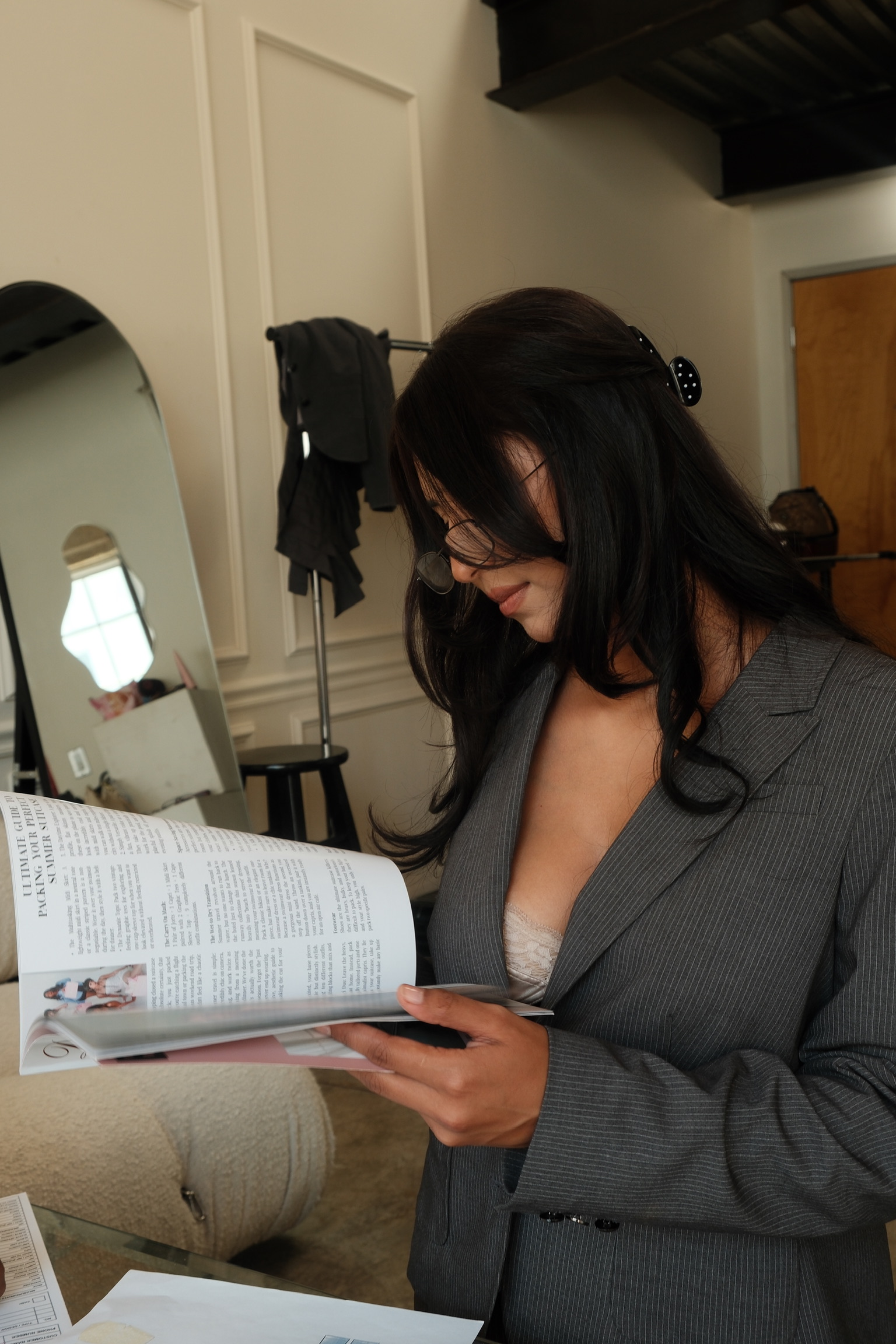
There's a particular kind of photograph that defined the '90s, and it was rarely taken on assignment. Once upon a time, "model off-duty" wasn't an aesthetic; it was simply what happened after the show ended.
Long before algorithms dictated what we wore, before every coffee run doubled as a photo opportunity, and before "Get Ready With Me" videos transformed getting dressed into a performance, there were the supermodels of the '90s. When they stepped off the runway, they traded couture for clothes that looked lived-in, familiar, almost incidental—and somehow, that became fashion.
The 1990s marked a decisive shift in the fashion landscape. The unapologetic excess of the '80s—with its exaggerated shoulders, saturated colors, conspicuous jewelry, and appetite for spectacle—began to give way to something quieter. Designers stripped silhouettes down to their essentials, favoring clean lines, restrained palettes, precise tailoring, and fabrics that spoke for themselves. Calvin Klein, Helmut Lang, Jil Sander, and Prada helped define a new visual language in which simplicity could feel just as luxurious as extravagance.
The mood shifted, and that philosophy extended far beyond the runway. Models weren't dressing to become street-style stars because, at the time, street style had barely become a cultural institution. There was no social media predicting the next microtrend, no Pinterest board dissecting an outfit piece by piece, and certainly no algorithm waiting to turn a candid photograph into a shopping list. They simply got dressed. And that, perhaps, was the magic.
In Kate We Trust
If the '90s had an unofficial patron saint of effortless dressing, it was Kate Moss. Her runway career was revolutionary enough, but it was what happened after work that cemented her influence. Paparazzi photographs caught her moving through London in oversized leather jackets that appeared to have been thrown on without a second thought, vintage Levi's sitting low on her hips, and silk slip dresses disappearing beneath worn-in cardigans. Tiny sunglasses, ballet flats, skinny scarves, battered boots—the pieces were familiar, but on Moss they acquired an unmistakable sense of insouciance. Nothing looked overly polished or precious, and that was precisely the point.
There was always an element of contradiction to Kate Moss. On magazine covers and runways, she could become almost anything the image demanded: glamorous, rebellious, ethereal, provocative. Off duty, however, she could look almost disarmingly ordinary. She wasn't dressing to remind anyone that she was a supermodel. If anything, she seemed intent on dressing like someone who had simply walked out of her front door. That tension became part of her allure.
Moss also understood something that fashion has spent decades trying to relearn: clothes become more interesting when they look as though they belong to a life. She mixed designer pieces with vintage finds long before secondhand fashion became a luxury category of its own. A delicate silk slip might be thrown beneath a battered leather jacket; a masculine blazer could hang loosely over a white tank; a pair of worn boots could make an otherwise polished outfit feel deliberately undone. She wasn't interested in looking untouched. The clothes looked worn, lived in, and distinctly hers.
Today, scroll through Pinterest or TikTok and you'll find thousands of outfits labeled "model off-duty." More often than not, they're simply recreations of something Kate Moss wore thirty years ago.
The Beauty of Not Trying So Hard
Then there was Carolyn Bessette-Kennedy, whose wardrobe has since become synonymous with understated elegance. Her approach was more polished than Moss's, but the philosophy was remarkably similar: resist excess, prioritize proportion, and let the clothes speak quietly. White shirts, black turtlenecks, camel coats, tailored trousers, and streamlined dresses formed the foundation of a wardrobe that felt considered without ever appearing overworked.
Bessette-Kennedy wasn't following trends so much as constructing a visual language of her own. She understood the power of repetition, and her wardrobe functioned almost as a uniform—recognizable, restrained, and endlessly sophisticated.
Meanwhile, supermodels such as Naomi Campbell and Linda Evangelista embodied one of fashion's most fascinating contradictions. Hours earlier, they might have been transformed beneath runway lights into extravagant visions of couture, complete with dramatic makeup, elaborate hair, and sculptural silhouettes. By evening, photographers could find them in oversized coats, knit sweaters, sneakers, or baseball caps, carrying garment bags through airports. The difference was striking: it reminded us that even fashion fantasy had an off switch.
Before Personal Style Became Personal Branding
Looking back, what makes these photographs so captivating isn't simply the clothing; it's the absence of performance.
There weren’t any affiliate links beneath a photograph, no carefully edited "day in my life," and no comment section dissecting whether an outfit was sufficiently on trend. These women worked in fashion, so of course they cared about clothes. But their wardrobes weren't being assembled for an audience of millions or calibrated to satisfy an algorithm. They were dressing for long flights, castings across town, late dinners, unpredictable weather, and ordinary mornings. Comfort and confidence quietly outweighed spectacle.
Of course, the idea that the '90s model off-duty look was entirely accidental is a romanticization. These women were professionals surrounded by designers, photographers, stylists, and editors; they understood the power of an image better than most. But there is an important distinction between knowing how to dress and dressing specifically to be seen. The latter is what has changed.
The photographs captured women in the margins of their professional lives—walking down a sidewalk, leaving a restaurant, waiting for a car, arriving at an airport. They weren't necessarily presenting themselves. They were simply existing in clothes. Ironically, that lack of intention became one of the most aspirational images fashion has ever produced.
The Effort Behind Effortless
Fast-forward to the 2020s, and model off-duty is everywhere again. The leather bomber has returned, ballet flats have emerged from retirement, and the white tank has once again established itself as a wardrobe essential. Slim sunglasses, oversized totes, low-rise denim, black blazers, loafers, and deliberately undone hair have all found their way back into the cultural conversation. The clothes haven't changed very much, but what has changed is the intention behind them.
Today, there are endless tutorials explaining how to achieve the "effortless" look. Entire wardrobes are purchased with the specific objective of appearing as though no wardrobe was purchased at all. Social media has transformed spontaneity into a checklist: an oversized jacket, a simple white tank, slicked-back hair, vintage denim, headphones resting around the neck. It's fascinating, really. We're studying photographs of women who weren't trying to create an aesthetic so that we can intentionally recreate one. Somewhere along the way, "effortless" became one of fashion's most labor-intensive illusions.
Can Authenticity Be Recreated?
Fashion has always borrowed from the past. Trends return because new generations reinterpret old ideas through a contemporary lens, and there is nothing inherently inauthentic about that. After all, imitation is one of the ways fashion survives.
But the revival of model off-duty dressing raises a more complicated question: can something still feel authentic once everyone knows the formula?
The original appeal of the '90s look wasn't simply the leather jackets, straight-leg jeans, or slip dresses. It was the ease behind them—the suggestion that the clothes belonged to the person wearing them, rather than the person having to perform the clothes. That's much harder to replicate than a Pinterest board.
Perhaps that's why those grainy paparazzi photographs still feel more compelling than countless perfectly curated Instagram posts. They captured something that cannot easily be manufactured: women caught between destinations, between jobs, between moments. They were tired, busy, probably running late—and somehow, impossibly chic.
There is a reason Kate Moss's photographs from three decades ago continue to circulate alongside today's trend reports. The clothes themselves are not particularly revolutionary anymore. What remains captivating is the attitude: the refusal to look as though anyone was trying too hard. The irony is that fashion has spent thirty years attempting to reproduce that feeling.
Maybe the original model off-duty uniform was never really about dressing like a model at all. Maybe it was about dressing like someone with somewhere more important to be.